はじめに, Introduction
2011年3月11日に東日本大震災が発生し、福島第一原子力発電所の原子炉が3基とも炉心溶融を起こしました。建物の破壊や放射性気流の外部流出により近郊は強く放射能汚染されました。放射性気流は風に乗って東京方面まで流れました。この時雨が降った地域に放射性物質が雨と共に落下して、発電所から約200 km離れた地域が放射能汚染されました。この地域の住民の一人として、長時間(今年で13年)にわたり放射線量率の時間依存性の定点観測を続けてきました。これは、東日本大震災に対する私の追悼です。
The Great East Japan Earthquake occurred on March 11, 2011, and all three reactors at the Fukushima Daiichi Nuclear Power Plant suffered core meltdowns. The surrounding area was heavily radioactively contaminated due to the destruction of buildings and the outflow of radioactive air currents. The radioactive air flow was carried by the wind as far as Tokyo. At this time, radioactive materials fell with the rain in areas where it rained, and an area approximately 200 km away from the power plant was radioactively contaminated. As a resident of this area, I have been conducting fixed-point observations of the time dependence of radiation dose rates for a long time (13 years this year). This is my memorial for the Great East Japan Earthquake.
原子核の発見, Discovery of the atomic nucleus
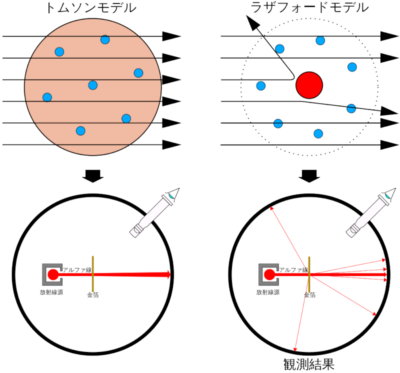
左: 期待された結果:α粒子は原子のプラムプディング・モデルを通過し、偏光は軽微である。
右: 観測された結果: 粒子の一部が原子核に集中した正電荷による偏向を示した。
ベクレルは、天然のウラン鉱石が放射線を出すことを1896年に発見しました。1901年にソディはトリウムが放射線を出してラジウムへ変換することを発見[1]しました。化学結合で出来た分子は化学反応で比較的簡単に変化します。いろんな物が酸素と化学反応して光や熱を出すことなどは普通に見られる現象です。でも、トリウムからラジウムへ変換する現象は、それまで知られていた化学反応の知識では理解できませんでした。当時は原子の構造も分かってなくて、正に帯電した球の中に多くの負に帯電した微粒子が分布して構成されていると考えられていたのです。1911年、ラザフォードは新しい原子模型を発表しました。それは、原子は小さい高密度の正に帯電した核とその周りに軽く、負に帯電した電子がある距離をもって回転しているというモデル[2]です。1919年、ソディの同僚だったラザフォードは窒素にアルファ粒子を照射して酸素に核変換することに成功[1]しました。このことによって、化学反応とは異なる核変換の研究が進むことになりました。ここで、物質の性質は不連続的に変化することに注目しましょう。化学反応が進むうえで必要なエネルギーの量を仮に1とします。原子核の反応にはその106倍ほどのエネルギーが必要なのです。分子、原子、原子核、核子、素粒子のような分類は物質の階層性と理解されています。かつて卑金属から金を製錬しようとする錬金術が中世時代に行われました。これは、化学反応のエネルギー程度で原子核を変換しようとした徒労[3]だったことが分かります。
Becquerel discovered in 1896 that natural uranium ore emits radiation. In 1901, Soddy discovered that thorium emitted radiation and was converted to radium.[1] Molecules made of chemical bonds are relatively easily changed by chemical reactions. It is a common phenomenon that various substances chemically react with oxygen and emit light and heat. However, the phenomenon of converting thorium to radium could not be understood using the knowledge of chemical reactions known until then. At that time, the structure of atoms was not even understood, and it was thought that atoms were composed of many negatively charged particles distributed within a positively charged sphere. In 1911, Rutherford introduced a new model of the atom. It is a model in which an atom consists of a small, dense, positively charged nucleus surrounded by light, negatively charged electrons rotating a certain distance.[2] In 1919, Soddy’s colleague Rutherford succeeded in transmuting nitrogen into oxygen by bombarding it with alpha particles.[1] This led to progress in research on nuclear transmutation, which is different from chemical reactions. Note here that the properties of matter change discontinuously. Let us assume that the amount of energy required for a chemical reaction to proceed is 1. Nuclear reactions require about 106 times more energy. Classifications such as molecules, atoms, nuclei, nucleons, and elementary particles are understood as a hierarchy of matter. Alchemy, which attempted to smelt gold from base metals, was practiced in the Middle Ages. It turns out that this was a vain effort to convert the atomic nucleus with the energy of a chemical reaction.[3]
References
- 核変換, nuclear transmutation, Wikipedia, https://ja.wikipedia.org/wiki/%E6%A0%B8%E5%A4%89%E6%8F%9B
- Rutherford model, Britannica, https://www.britannica.com/science/Rutherford-model
- 学術俯瞰講義, http://www.icepp.s.u-tokyo.ac.jp/~asai/Lecture/fukan1.pdf
to be continued…