核分裂反応, Nuclear fission
放射性元素は宇宙の生成と共にできたものなので、地球のどこにでも存在します。現在地球には生命誕生と進化によって微生物から人類に至るまでたくさんの生き物がいます。地球の年齢は約45億年[7]と見積もられています。なぜこんなに長期間にわたって地球は生命をはぐくむ環境を維持してきたのか?とても不思議です。19世紀末に活躍した著名な物理学者ウィリアム・トムソンは、初期の熱い星が徐々に冷えていくモデルに基づき地球の年齢を計算しました。その結果は、9800万年、不確定要素を考慮すれば2000万年から4億年でした。しかし、同時代に進化論を提唱したチャールズ・ダーウィンはこれでは生命が進化する時間には短過ぎると悩みました。[7]
20世紀に入り放射能が発見され、放射性崩壊することにより周囲の温度を上昇させることが発見されました。ラザフォードは、放射性元素が地球の熱源になっていることを発表しました。そして現在、地球内部で発生する熱の大半は、天然放射性元素が崩壊する時の熱に由来する[8]ことが解明されています。地球の内部構造は、中心から外に向かって、内核、外核、マントル、地殻から構成されていると理解されています。内核は鉄やニッケルの固体金属であり温度は5,000K以上、外核は不純物を含む鉄やニッケルの溶融金属であり温度は3,000K以上、マントルは固体岩石であり温度は1,900K以上、地殻は固体です。
マントルは固体ですが、高温度の外核に接して熱くなりゆっくり地殻に向かって上昇し、地表では海嶺を形成します。冷えたマントルは海溝やトラフと呼ばれている部分で内部に沈み込みます。このような「マントルの対流」により冷えたマントルの作るプレートはゆっくり移動することになります。生命の誕生と進化は、このプレートテクトニクス、大気の組成、磁場を作る地球のコアなど、互いに関連しあったシステムの一部[9]と考えられています。
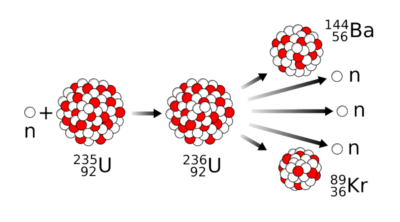
Nuclear reaction theoretically derived by Meitner and Frisch. Wikipedia
放射性元素は生命の誕生と進化とって重要な役割を果たしていることが理解されている一方、私達は原子爆弾の恐ろしさを知っています。原子爆弾の発明につながる核分裂は40年以上にわたる放射能の科学と核物理学の研究を経て、1938年にドイツで発見された[6]のでした。広島に投下された原子爆弾はウラン235の核分裂反応を利用したものでした。1グラムのウラン235が核分裂を起こすと、私達1世帯が約2年半に消費するエネルギーを放出する[6]と見積もられます。原子爆弾はこの膨大なエネルギーを爆発的に放出させて人や物を破壊する兵器であり、広島では一瞬にして街並みが破壊され、放射能による急性障害が一応収まった1945年12月末までに、約14万人が亡くなったと推定[10]されています。
Nuclear fission
Radioactive elements were created along with the creation of the universe, so they exist everywhere on Earth. Today, there are many living things on Earth, from microorganisms to humans, due to the birth and evolution of life. The age of the Earth is estimated to be approximately 4.5 billion years.[7] Why has the Earth maintained an environment that supports life for such a long time? It’s very strange. William Thomson, a famous physicist active at the end of the 19th century, calculated the age of the Earth based on a model in which an early hot star gradually cooled. The result was 98 million years, or 20 to 400 million years, taking into account uncertainties. However, Charles Darwin, who advocated the theory of evolution at the same time, was concerned that this was too short a time for life to evolve.[7]
Radioactivity was discovered in the 20th century, and it was discovered that radioactive decay increases the temperature of the surrounding area. Rutherford announced that radioactive elements were the source of Earth’s heat. It has now been revealed that most of the heat generated inside the Earth comes from the heat generated when natural radioactive elements decay.[8] The Earth’s internal structure is understood to consist of an inner core, an outer core, a mantle, and a crust, working outward from the center. The inner core is solid metal such as iron and nickel and has a temperature of over 5,000K, the outer core is molten metal such as iron and nickel containing impurities and has a temperature of over 3,000K, the mantle is solid rock and has a temperature of over 1,900K, and the crust is solid.
Although the mantle is solid, it heats up in contact with the high-temperature outer core and slowly rises toward the Earth’s crust, forming ocean ridges at the Earth’s surface. The cooled mantle sinks into the ocean at areas called ocean trenches and troughs. Due to such “mantle convection”, the plates formed by the cooled mantle move slowly. The birth and evolution of life is considered to be part of an interconnected system that includes plate tectonics, the composition of the atmosphere, and the Earth’s core that creates the magnetic field.[9]
While we understand that radioactive elements play an important role in the birth and evolution of life, we also know the horror of atomic bombs. Nuclear fission, which led to the invention of the atomic bomb, was discovered in Germany in 1938 after more than 40 years of research in the science of radioactivity and nuclear physics.[6] The atomic bomb dropped on Hiroshima used the nuclear fission reaction of uranium-235. It is estimated that when 1 gram of uranium-235 undergoes nuclear fission, it releases enough energy to be consumed by a single household for about two and a half years.[6] The atomic bomb is a weapon that destroys people and property by releasing a huge amount of energy explosively, and the cityscape of Hiroshima was destroyed in an instant, and by the end of December 1945, when the acute damage caused by radiation had subsided, it is estimated that approximately 140,000 people died.[10]
短寿命の核種は放射能が大きい, Short-lived nuclides have high radioactivity.
戦後になって、核分裂によって得られるエネルギーを利用した原子力発電所が世界に作られるようになりました。原子爆弾と同じ物理現象を爆発が起こらない濃度範囲に抑えた核燃料で起こさせて熱エネルギーを取り出すのです。得られた熱で水蒸気を作りタービンを回転させ発電します。電気エネルギーに変換されれば、それは放射線を出すこともなく安全に利用できます。問題は、核分裂によって生じる核分裂生成物を安全に管理できるかです。核分裂生成物は色々な核種を含み、多くは放射能を持ちます。半減期で見れば、短寿命(1か月以内など)、中寿命(100年単位)、長寿命(20万年超など)の核種が存在[6]します。ここで注意が必要なのが、短寿命の核種です。ラザフォードとソディの法則から定量的に分かるのですが、短寿命の核種は盛んに放射線を放って崩壊するため少量でも放射能は大きいのです。その例は、原子爆弾の投下された広島市と長崎市では、爆発時の被爆者だけでなく、家族や知人を探すため爆心地周辺に後日立ち入った人々が重篤な放射線障害を発症した[6]ことです。
Short-lived nuclides have high radioactivity.
After the war, nuclear power plants that utilize the energy obtained from nuclear fission began to be built around the world. Heat energy is extracted by causing the same physical phenomenon as an atomic bomb to occur with nuclear fuel at a concentration that does not cause an explosion. The heat obtained is used to create steam, which rotates a turbine and generates electricity. Once converted into electrical energy, it can be used safely without emitting radiation. The question is whether the fission products produced by nuclear fission can be safely managed. Nuclear fission products contain various nuclides, many of which are radioactive. In terms of half-life, there are nuclides with short lifespans (such as within a month), medium-lives (on the order of 100 years), and long-lives (such as over 200,000 years).[6] What you need to be careful about here is short-lived nuclides. As we can quantitatively understand from Rutherford and Soddy’s law, short-lived nuclides actively emit radiation and decay, so even a small amount has a large amount of radioactivity. An example of this is that in Hiroshima and Nagasaki, where the atomic bombs were dropped, not only the survivors at the time of the explosion, but also those who later entered the area around the hypocenter to search for family and friends developed serious radiation sickness.[6]
References
[6] 核分裂反応, Wikipedia, https://ja.wikipedia.org/wiki/%E6%A0%B8%E5%88%86%E8%A3%82%E5%8F%8D%E5%BF%9C
[7] 地球の聯例, Wikipedia, https://ja.wikipedia.org/wiki/%E5%9C%B0%E7%90%83%E3%81%AE%E5%B9%B4%E9%BD%A2
[8] 地熱, Wikipedia, https://ja.wikipedia.org/wiki/%E5%9C%B0%E7%86%B1
[10] 広島市 死者数について, https://www.city.hiroshima.lg.jp/soshiki/48/9400.html
to be continued…