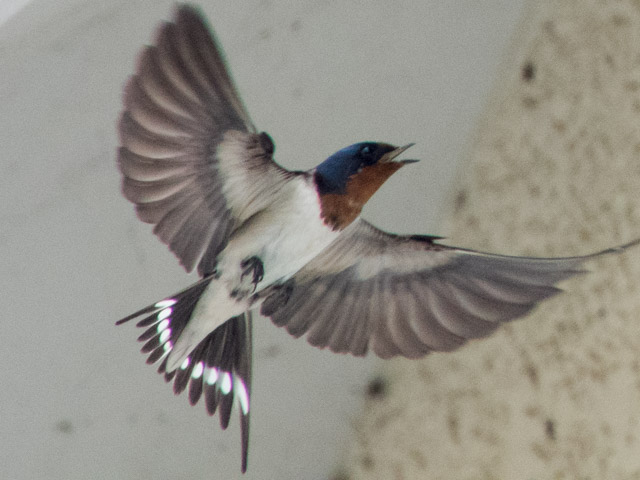
和名: ツバメ, English: Barn swallow, Espanol: Golondrina comun, Binomial name: Hirundo rustica (Linnaeus, 1758)
Wikipedia
スズメ目 > ツバメ科 > ツバメ属 > ツバメ
Order: Passeriformes > Family: Hirundinidae > Genus: Hirundo > Species: H. Rustica
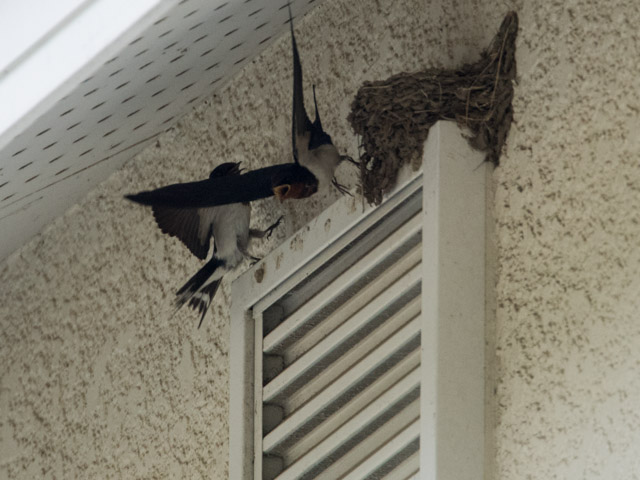
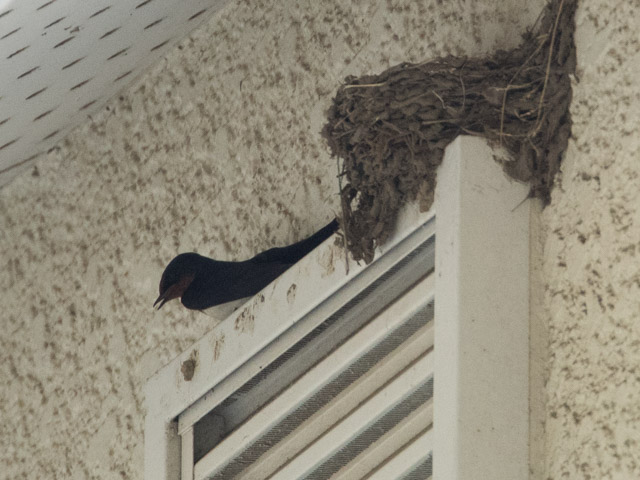
ツバメが民家の軒下の壁に巣を作っていた。A pair of swallows were making a nest on the wall under the roof of a private house.
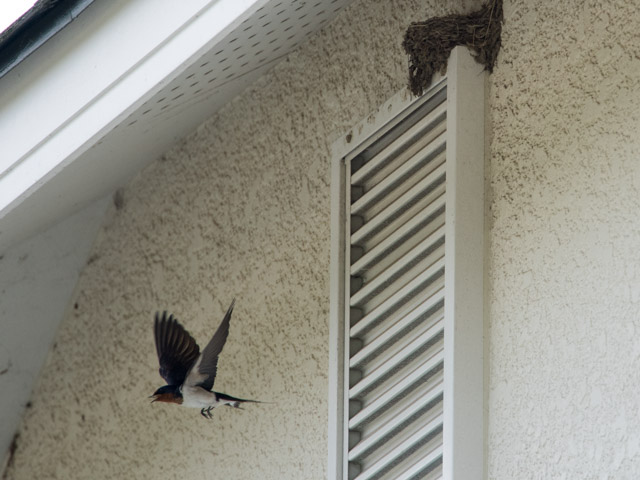
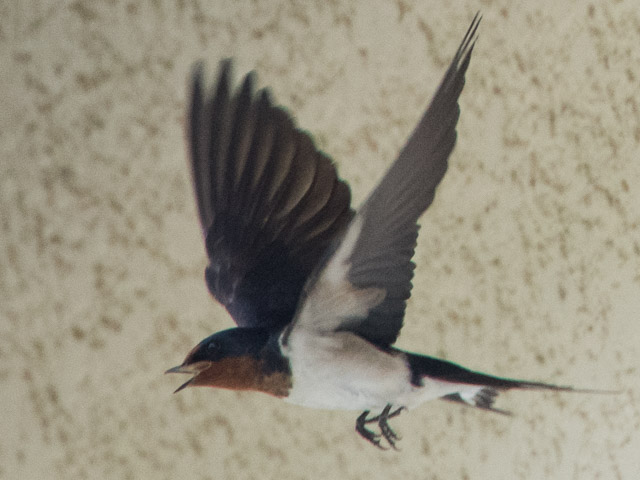
ツバメは泥と枯草を唾液で固めて巣を造る。私は南米のパラグアイでセアカカマドドリの巣作りを見た。ツバメと似た方法で巣をつくるが、外形は丸いかまど状であり、内部は出入り口と育成室の間に隔壁を持つ構造を持つ。天敵から雛を守るためにこの驚くべきスキルを獲得したのだろう。
The swallow makes the nest made of mud and dry grass hardened with saliva. I watched the nest making of Rufous hornero in Paraguay of South America. The hornero makes a nest with similar method to the swallow, but the shape of the nest is like a round oven and the inside has structure to have partition between the doorway and an upbringing room. The hornero would get this surprising skill to protect the fledgling from natural enemies.
日本で見るツバメは喉と額が赤く、腹部は白い。北アメリカで繁殖するツバメは喉だけでなく腹部も赤い。これらはツバメ属ツバメの2亜種だ。私は南米のパラグアイで北アメリカから越冬のために渡ってきた腹部の赤いツバメを見た。パラグアイで普通見るツバメは、ムラサキツバメ属のハイムネムラサキツバメとチャムネツバメだった。これらのツバメは渡りを行わず、喉は白っぽく赤っぽい羽毛を持たない。私は南米で5種のツバメを見たが、この中で、渡りを行うツバメ属ツバメが世界中に最も多く分布している。ツバメ科の鳥を見ただけでも生物多様性を実感する。
Swallows which we see in Japan have red throat and forehead and white belly. Swallows which bleed in North America have not only read throat but also red belly. These are two subspecies of Barn swallow of genus Hirundo. I saw swallows with red belly which came from North America for wintering to Paraguay in South America. Popular swallows in Paraguay were Grey-breasted martin and Brown-chested martin of genus Progne. These swallows do not migrate and the throat is whitish without any reddish feather. I saw five species of swallows in South America. Among them, the barn swallow is the most widespread species of swallow in the world. Only a small family of swallow gives me an impression of biodiversity.
(手賀沼公園 Tega-Pond Park, Chiba, Japan, 11:09, May 23, 2016, D810)
鳴管が発達しており、繁殖期になるとオスはチュビチュビチュビチュルルルルと比較的大きなさえずり声で鳴く。飛翔する昆虫などを空中で捕食する。また、水面上を飛行しながら水を飲む。
Wikipedia
泥と枯草を唾液で固めて巣を造る。ほとんど人工物に造巣し、民家の軒先など人が住む環境と同じ場所で繁殖する傾向が顕著である。これは、天敵であるカラスなどが近寄りにくいからだと考えられている。
日本においては、水稲栽培において穀物を食べず害虫を食べてくれる益鳥として古くから大切にされ、ツバメを殺したり巣や雛に悪戯をする事を慣習的に禁じ、農村部を中心に大切に扱われてきた。
The barn swallow (Hirundo rustica) is the most widespread species of swallow in the world. It is a distinctive passerine bird with blue upperparts, a long, deeply forked tail and curved, pointed wings. It is found in Europe, Asia, Africa and the Americas. In Anglophone Europe it is just called the swallow; in Northern Europe it is the only common species called a “swallow”.
The barn swallow is a bird of open country that normally uses man-made structures to breed and consequently has spread with human expansion. It builds a cup nest from mud pellets in barns or similar structures and feeds on insects caught in flight. This species lives in close association with humans, and its insect-eating habits mean that it is tolerated by man; this acceptance was reinforced in the past by superstitions regarding the bird and its nest. There are frequent cultural references to the barn swallow in literary and religious works due to both its living in close proximity to humans and its annual migration. The barn swallow is the national bird of Austria and Estonia.