千葉県立美術館の展覧会, Exhibition at The Chiba Prefectural Museum of Art
「アーツ・アンド・クラフツとデザイン ウィリアム・モリスからフランク・ロイド・ライトまで」 2024年1月30日(火) ~ 2024年3月24日(日)
“Arts & Crafts and Design: from William Morris to Frank Lloyd Wright” January 30, 2024 (Tuesday) – March 24, 2024 (Sunday)
第1章 モリス・マーシャル・フォークナー商会とモリス商会, Morris Marshall Faulkner & Co. and Morris & Co.
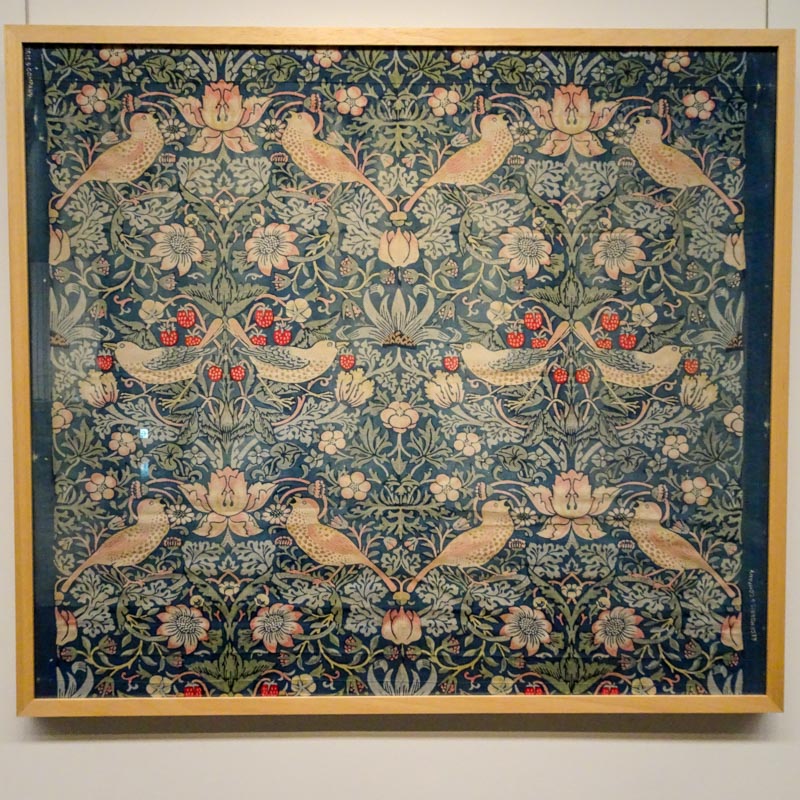
いちご泥棒, Strawberry Thief
モリス1883-1834 = 49歳の作品, A work by Morris, 49 years old.
いちご泥棒, Strawberry Thief
作品のキャプション, Caption of the work
ウィリアム・モリス. William Morris
1883年 木版、色刷り、インディゴ抜染、木綿
モリス商会
近代化や商業主義に対するモリスの反発は、手仕事や天然素材への拘りにつながった。それが最も顕著に表れたのが、インディゴ染めへの情熱である。化学染料に駆逐され忘れられていたインディゴの抜染法を、自ら実験を重ね復活させた。本作は、抜染に木版で他の色を重ねた複雑な技法に成功した最初のデザイン。別荘のいちごをついばみに来たツグミに着想を得たと言われるが、愛らしいネーミングも人気の理由だろう。
作品のキャプション, Caption of the work
Morris’s opposition to modernization and commercialism led to his obsession with handicrafts and natural materials. The most obvious example of this was his passion for indigo dyeing. Through repeated experiments, he revived the indigo discharge printing method, which had been forgotten due to the use of chemical dyes. This work is the first design to succeed in the complex technique of discharging printing and layering other colors with woodblock printing. It is said that he was inspired by the thrushes that came to peck at the strawberries at the villa, and the adorable name is probably the reason for its popularity.
インディゴの抜染, Indigo Discharge
モリスが1975~1985年のテキスタイル・プリントに熱中した時期に利用したのはもっぱら天然染料で,その中でもとりわけインジゴ,茜,ウエルドが多く使われた。単色,重ね染めのほかに,抜染,媒染の効果も応用された。
齋藤益美,脇田登美司, 岐阜女子大学紀要 第32号(2003.3)p. 81, https://gijodai.jp/library/file/kiyo2003/09-2003.pdf
…
有名な「いちご泥棒」は,インジゴで染色したあと抜染を行い,さらに青,赤,黄を次々に染められ,プリントされたものである。
…
このようなインジゴで染色した綿,絹,羊毛織物に,漂白剤で模様を白く抜く白色抜染や半抜染が行われていた(この場合,漂白剤が現在の抜染に利用されているハイドロサルファイトあるいは発色までの安定性を保った亜硫酸亜鉛/ホルマリン縮合体のような,抜染剤がすでに使われていたかどうか明らかでない)。
During Morris’s textile printing obsession from 1975 to 1985, he used mostly natural dyes, most notably indigo, madder, and weld. In addition to single-color and layered dyeing, discharge dyeing and mordant effects were also applied.
… The famous “Strawberry Thief” was printed after being dyed with indigo, discharge printed, and then dyed blue, red, and yellow one after another.
… White discharge printing or semi-discharge printing was performed on cotton, silk, and wool fabrics dyed with indigo, in which the patterns were whitened using bleach (It is not clear whether such discharge printing agents were already in use as hydrosulfite or zinc sulfite/formalin condensate, which are used in current discharge printing.).